When Privacy Meets Profit: The New Reality of Telematics in Trucking Insurance
In the trucking industry, there’s a conversation happening right now that goes far beyond insurance. It’s a conversation about technology, privacy, artificial intelligence, business operations, and the changing reality of what it now costs to operate a commercial vehicle. And whether people like it or not, telematics has officially become part of that conversation.
At Resilient Risk, we recently experienced a situation that perfectly illustrates where the commercial transportation insurance market is heading. A trucking client was originally quoted at approximately $6,200 annually for coverage. However, the pricing was tied to a telematics program requiring a device to be installed in the truck. The device was not installed initially, and the premium was eventually rerated to nearly $18,000 per year. That is not a typo. The difference between participating in the telematics program and refusing it was almost $12,000 annually.
This Is Bigger Than One Client
What made this situation especially interesting was that the client eventually understood the financial reality. He understood:
- The device needed to be installed,
- The lower premium depended on it,
- And the rate increase was directly tied to the lack of participation.
He ultimately agreed to plug in the device to preserve the lower premium. But at the same time, he still asked, “Can you work on finding a way around this device?” And honestly, that question says a lot about where many trucking operators are mentally right now.
There is still a significant level of resistance to tracking technology, telematics, AI-driven underwriting, and real-time monitoring. Especially among business owners who built companies during a time when insurance was based more heavily on applications, conversations, and relationships rather than data streams and behavioral analytics.
Personal Beliefs vs. Business Decisions
This is where trucking operators need to separate personal feelings from business economics. And to be clear — privacy concerns are understandable. Personally, I do not even use telematics in my own personal vehicle. I understand wanting some level of privacy in your everyday life. Many people are uncomfortable with the idea of devices monitoring movement, routes, braking habits, or driving behavior. That concern is valid.
But a business vehicle is different. A commercial truck is not just transportation — it is an income-producing asset. It is part of a business operation. And in business, decisions often have to be made based on financial impact, operational efficiency, risk management, and long-term sustainability. Not simply personal preference.
The Insurance Industry Has Changed
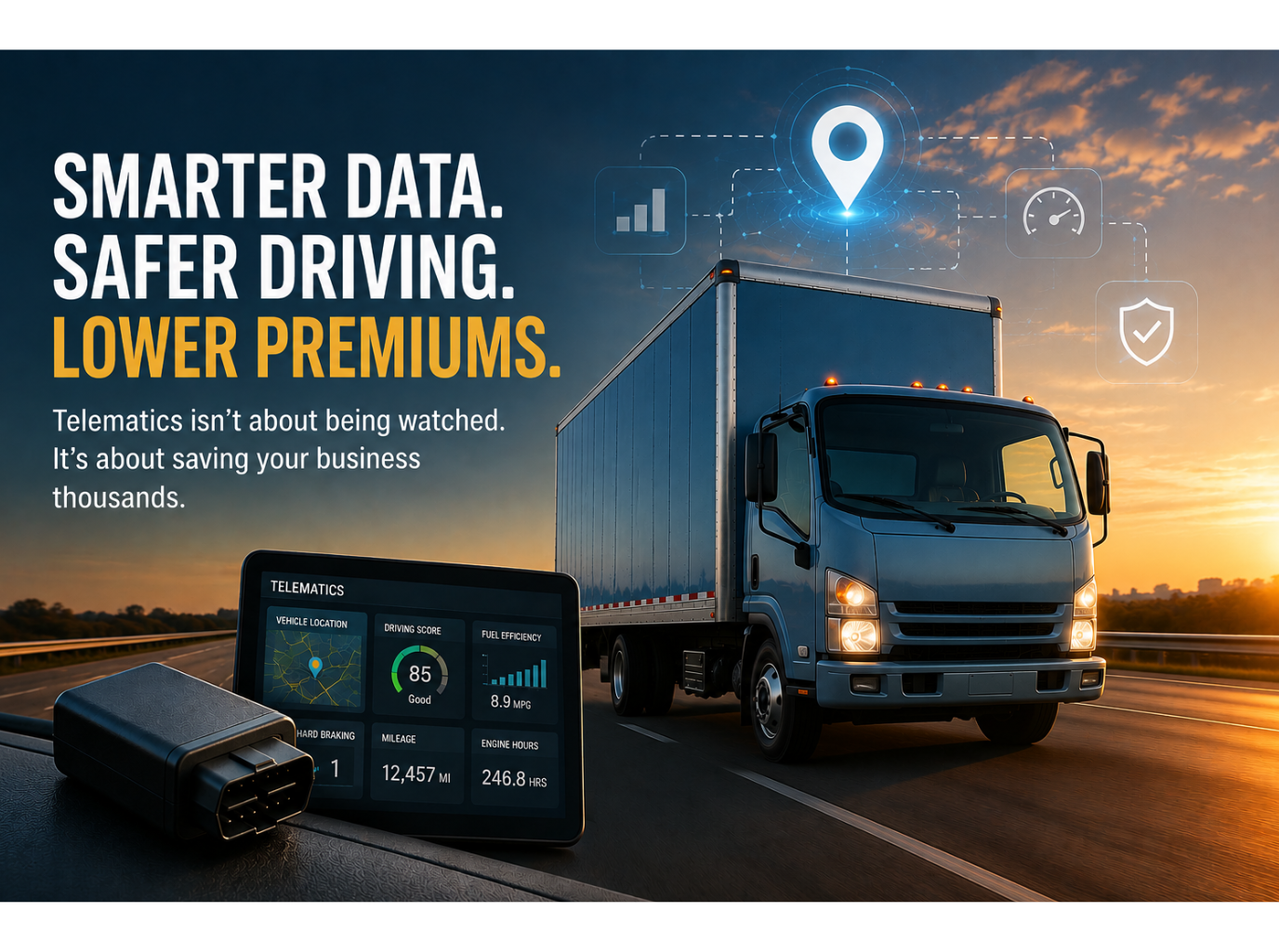
The reality is that commercial transportation insurance has become heavily data-driven. Insurance carriers now want location verification, mileage confirmation, operational consistency, theft recovery capability, and in some cases, driving behavior analytics. For many transportation risks, telematics is no longer viewed as an optional discount program. It is becoming an underwriting expectation.
Particularly for box trucks, sprinter vans, local delivery operations, last-mile logistics, and newer trucking ventures. Drivers who refuse telematics entirely are increasingly finding themselves with fewer carrier options, higher premiums, stricter underwriting, and reduced market competitiveness. In many cases, refusing the device can mean paying double or even triple the premium.
The Market Is Moving Forward
This article is not about whether telematics is “good” or “bad.” Reasonable people can debate privacy concerns all day long. But from a business standpoint, trucking operators need to understand something important: The market has already moved.
Insurance companies are investing billions into predictive analytics, AI-driven underwriting models, and real-time operational data. Carriers are rewarding operators who participate in these programs because the data helps them measure and manage risk more effectively. That trend is not slowing down.
Trying to completely avoid telematics in commercial transportation today is becoming similar to trying to avoid ELDs years ago. At some point, the industry standard changes whether operators are comfortable with it or not.
A Different Way to Look at It
There is also another side to this conversation that many operators overlook. If this truck is your livelihood, then having systems that encourage safer and more disciplined operation may not necessarily be a bad thing. In some cases, telematics can help improve driving habits, reduce claims, recover stolen vehicles, monitor operational efficiency, and create accountability.
And if installing a device can save a business $10,000 or more annually, that becomes a serious financial decision — not just a philosophical debate.
Final Thoughts
The trucking industry is evolving quickly. Technology, AI, telematics, and real-time data are reshaping how transportation insurance is priced and underwritten. Business owners do not necessarily have to love these changes. But they do need to understand them. Because in today’s market, adapting to the industry is often far less expensive than fighting against it.
And sometimes, the difference between resisting change and accepting it can be nearly $12,000 per year. For more insights and personalized advice on how telematics can impact your insurance premiums, feel free to reach out to our agency. We’re here to help you navigate these changes and make informed decisions for your business.